

Executive Summary
A domestic violence accusation in New Jersey moves faster and reaches further than almost any other legal matter. Within hours, a person can be removed from their home, barred from seeing their children, ordered to surrender every firearm they own, and charged with a crime — all before a single fact has been tested in court. And because these cases run on two separate legal tracks at once — a civil restraining order in the Family Part and a criminal charge for the underlying offense — a person can lose one while winning the other.
This guide is the definitive resource on domestic violence defense in Hackensack and Bergen County. It explains, in plain language, what legally qualifies as domestic violence under New Jersey’s Prevention of Domestic Violence Act, how temporary and final restraining orders work, what happens after an arrest, the penalties and lifelong collateral consequences at stake, the defenses that actually work, and the far-reaching effects on firearms, immigration, employment, licensing, and child custody. Whether you were served with a restraining order last night or are trying to understand a charge before your first court date, this page will help you understand exactly what you are facing — and how a strong defense protects your rights, your record, and your future.
Key Takeaways
- Domestic violence is not a single crime in New Jersey. It is a legal category triggered when a person in a protected relationship commits one of a specific list of predicate offenses.
- Cases run on two parallel tracks — a civil restraining order (decided by a judge on a low standard of proof) and a criminal charge (which the State must prove beyond a reasonable doubt). When children are involved, a third child-welfare track can open.
- A Final Restraining Order in New Jersey never expires, cannot be expunged, and carries firearms, immigration, employment, and custody consequences — even without any criminal conviction.
- Arrest is often mandatory, and firearms are typically seized immediately, regardless of the alleged victim’s wishes.
- The first hours matter most. Staying silent, honoring every order, avoiding all contact, preserving evidence, and getting experienced counsel quickly protect every option that follows.
- These cases are defensible. The plaintiff and the State carry the burden of proof, and complete records, credibility challenges, and careful strategy frequently change outcomes.
Table of Contents
- Quick Answer: Domestic Violence in New Jersey
- The Two-Track System
- What Qualifies as Domestic Violence
- Predicate Acts Explained
- Criminal Charges and Penalties
- Restraining Orders: TRO vs. FRO
- Police Investigation and the Arrest Process
- Bail and Pretrial Release
- The Court Process, Step by Step
- Evidence in Domestic Violence Cases
- Defense Strategies
- False and Exaggerated Allegations
- Firearms and Weapons Forfeiture
- Child Custody and Endangerment
- Immigration Consequences
- Professional Licensing and Employment
- Expungement and the Central Registry
- Rights of the Accused and the Alleged Victim
- Appeals
- Common Mistakes to Avoid
- What to Do After an Arrest
- Why an Experienced Attorney Matters
- Myth vs. Fact
- Frequently Asked Questions
- Glossary of Legal Terms
- Conclusion
Quick Answer: Domestic Violence in New Jersey
Is domestic violence a crime in New Jersey? Not by itself. “Domestic violence” is a legal category defined by the Prevention of Domestic Violence Act (N.J.S.A. 2C:25-17 et seq.). It arises when a person in a protected relationship commits one of a specific list of predicate criminal offenses — such as assault, harassment, terroristic threats, or stalking — against another. That triggers two things at once: a civil restraining order case in the Superior Court, Family Part, and a criminal prosecution for the underlying offense.
This single distinction — that domestic violence is a category layered on top of ordinary crimes, not a standalone offense — is the foundation for understanding everything that follows. It explains why a person can face a permanent restraining order without ever being convicted of a crime, why the civil and criminal cases have different rules, and why defending against a domestic violence allegation requires a strategy that addresses both fronts together.
When You Need an Attorney: The moment you are served with a temporary restraining order or arrested. The final restraining order hearing is typically held within about ten days, and the earliest decisions — about statements, evidence, and detention — are often the most important in the entire case.
The Two-Track System
The defining feature of New Jersey domestic violence law is that most cases proceed simultaneously on two independent tracks. They involve the same accuser and the same incident, but they are decided in different courtrooms under different rules — and beating one does not automatically beat the other.
| Feature | Civil Track (Restraining Order) | Criminal Track (Charge) |
|---|---|---|
| Court | Superior Court, Family Part | Municipal Court or Superior Court, Criminal Division |
| What’s at stake | A restraining order, custody terms, weapons forfeiture | Fines, probation, jail, a criminal record |
| Standard of proof | Preponderance of the evidence (more likely than not) | Beyond a reasonable doubt |
| Who drives it | The alleged victim (plaintiff) | The State, through the prosecutor |
| Jury? | No — decided by a judge | Possible for indictable offenses |
| Can the accuser end it? | May request dismissal, subject to court review | No — only the State can dismiss |
Definition — Civil vs. Criminal Proceedings: The civil restraining order case asks whether an order is needed to protect the alleged victim, decided by a judge on a “more likely than not” standard. The criminal case asks whether the State can prove a crime “beyond a reasonable doubt.” Because the civil standard is far lower, a restraining order can be entered against a person who is never convicted of — or even charged with — any crime.
When children are part of the household, a third track can open: an investigation by the state’s child-protection agency into whether a child has been abused or neglected, including through exposure to domestic violence. That process is civil, separate from both the criminal and family cases, and runs on its own timeline.
Handling these tracks as a coordinated whole — rather than as separate problems — is the core of effective domestic violence defense, and it is why comprehensive criminal defense representation is so valuable from the very first day.
What Qualifies as Domestic Violence
Whether conduct legally counts as domestic violence in New Jersey turns on two questions, and both must be answered “yes.”
Question One: Is There a Protected Relationship?
The Prevention of Domestic Violence Act applies only when the parties share a qualifying relationship. If they do not, the matter is handled as an ordinary criminal case — not as domestic violence, and not in the Family Part.
| Protected Relationship | Who It Covers |
|---|---|
| Spouse or former spouse | Current or former husband or wife |
| Household member (present or former) | People who live together now or lived together in the past |
| Child in common | Two people who share a child, or where one is pregnant by the other |
| Dating relationship | People who are dating or have dated, even without marriage or cohabitation |
The dating relationship and household member categories generate the most litigation because their edges are blurry. For dating relationships, New Jersey courts weigh factors such as the length of the relationship, the frequency and nature of contact, whether there was meaningful bonding beyond casual acquaintance, and whether the parties presented themselves as a couple. Even a brief, largely digital relationship can qualify.
Question Two: Was a Predicate Offense Committed?
A qualifying relationship alone is not enough. The accused must also have committed one of the criminal offenses the Act designates as a predicate act of domestic violence. If the conduct does not meet the elements of a listed offense, it is not domestic violence — even between spouses.
Definition — Predicate Act: One of the specific criminal offenses that, when committed within a protected relationship, constitutes domestic violence under New Jersey law. The Act does not create new crimes; it channels existing offenses into the domestic violence framework.
This two-question structure gives the defense two distinct lines of attack: challenge the relationship (which can remove the case from the Family Part entirely), or challenge whether the conduct actually meets a predicate offense’s elements.
Predicate Acts Explained
The predicate offenses span a wide range — from the most serious violent crimes to conduct involving no physical contact at all. The current list is set by statute and has been expanded over the years.
| Predicate Offense | Common Statute | What It Often Looks Like |
|---|---|---|
| Homicide | N.J.S.A. 2C:11-1 et seq. | The most serious category |
| Assault | N.J.S.A. 2C:12-1 | Striking, shoving, or causing bodily injury |
| Terroristic threats | N.J.S.A. 2C:12-3 | Threatening to kill or seriously harm |
| Kidnapping / criminal restraint / false imprisonment | N.J.S.A. 2C:13-1 to -3 | Confining or restricting another’s movement |
| Criminal coercion | N.J.S.A. 2C:13-5 | Compelling conduct through threats |
| Sexual assault / criminal sexual contact / lewdness | N.J.S.A. 2C:14-2 to -4 | Non-consensual sexual conduct or exposure |
| Robbery | N.J.S.A. 2C:15-1 | Theft with force or threat |
| Criminal mischief | N.J.S.A. 2C:17-3 | Damaging or destroying property |
| Burglary / criminal trespass | N.J.S.A. 2C:18-2 to -3 | Unlawful entry or presence |
| Harassment | N.J.S.A. 2C:33-4 | Repeated or alarming communications or conduct |
| Cyber-harassment | N.J.S.A. 2C:33-4.1 | Threatening or lewd online messaging |
| Stalking | N.J.S.A. 2C:12-10 | A course of conduct causing fear |
| Contempt of a DV order | N.J.S.A. 2C:29-9 | Violating an existing restraining order |
The list also includes a catch-all for other crimes involving the risk of death or serious bodily injury. In practice, a handful of predicates — harassment, simple assault, terroristic threats, and stalking — drive the majority of Bergen County filings.
The Non-Physical Offenses
Many people are surprised to learn that domestic violence in New Jersey does not require physical contact. Several of the most common predicates are based on communication or a pattern of conduct:
- Harassment can rest on communications made anonymously, at extremely inconvenient hours, in offensively coarse language, or in a manner likely to cause annoyance or alarm — provided they are made with purpose to harass.
- Cyber-harassment covers online threats or lewd content sent with intent to harm, and is generally a more serious offense than ordinary harassment.
- Stalking requires a course of conduct — a repeated pattern — that would cause a reasonable person to fear for their safety.
- Terroristic threats can rest on words alone when made to instill genuine fear of violence or death.
Each of these turns on intent and is measured against a reasonable-person standard, which is why context and the accused’s actual purpose are so central to the defense. A person facing a harassment charge or a stalking allegation alongside a restraining order is best served by counsel who understands how these communication-based offenses are proven and challenged.
Criminal Charges and Penalties
Because domestic violence is not itself a crime, the criminal penalty depends entirely on the underlying offense and how it is graded. New Jersey sorts offenses into a hierarchy, each with its own exposure.
| Offense Grade | Common DV Examples | General Maximum Exposure |
|---|---|---|
| Petty disorderly persons | Harassment | Up to 30 days jail; fine up to $500 |
| Disorderly persons | Simple assault | Up to 6 months jail; fine up to $1,000 |
| Fourth-degree crime | Stalking; contempt of a DV order; some aggravated assault | Up to 18 months prison; fine up to $10,000 |
| Third-degree crime | Terroristic threats; certain aggravated assault | 3–5 years prison; fine up to $15,000 |
| Second-degree crime | Serious aggravated assault | 5–10 years prison; fine up to $150,000 |
| First-degree crime | The most serious violent offenses | 10–20 years or more |
Two sentencing principles sharpen these numbers. First, New Jersey generally applies a presumption of incarceration for first- and second-degree crimes. Second, certain violent crimes fall under the No Early Release Act, which can require serving roughly 85% of the sentence before parole eligibility.
The grading decision is often the entire case. A physical altercation charged as a disorderly persons simple assault stays in municipal court with a maximum of six months; the same conduct charged as a second-degree aggravated assault moves to Superior Court and exposes the defendant to years in state prison. Scrutinizing how a charge is graded is one of the first tasks of the defense.
Enhanced Punishment for Repeat Conduct
New Jersey treats repeat conduct — and especially the violation of protective orders — with escalating severity. Contempt of a restraining order is generally a fourth-degree crime, and a second contempt conviction arising from a non-indictable act carries a mandatory minimum jail term, a rare instance where a court’s discretion to avoid jail is removed.
When You Need an Attorney: Before accepting any plea. A resolution that looks convenient can carry hidden, lasting consequences — to firearms rights, immigration status, professional licensing, and custody — that must be weighed before anything is accepted.
Restraining Orders: TRO vs. FRO
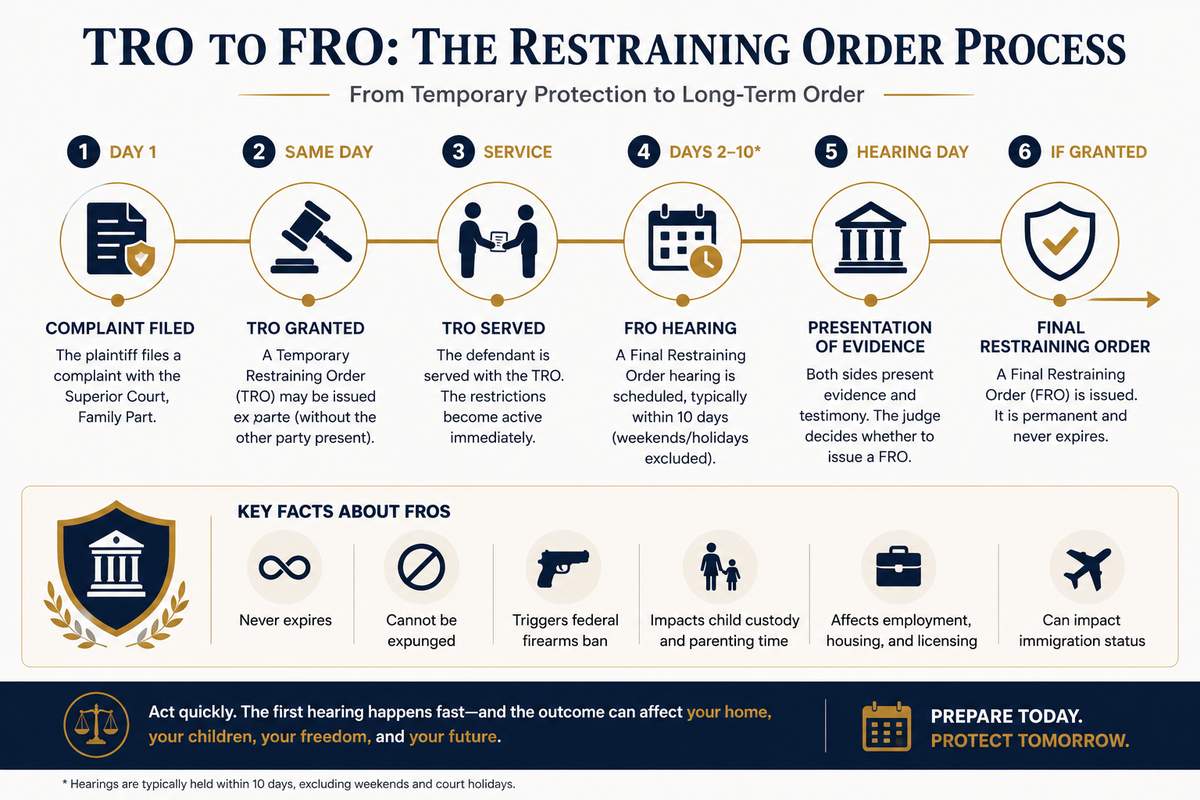
The restraining order is the civil half of a domestic violence case, and it is where events move fastest.
Definition — TRO vs. FRO: A Temporary Restraining Order (TRO) is a short-term, emergency order granted quickly — often without the accused present — to provide immediate protection. A Final Restraining Order (FRO) is entered only after a full hearing where both sides present evidence. Uniquely in New Jersey, an FRO has no expiration date.
How a TRO Is Obtained
During court hours, a plaintiff can seek a TRO at the Family Part; after hours, on weekends, and on holidays, through an on-call municipal court judge, often with police assistance. The hearing is ex parte — the accused is not present. The standard is low by design: the judge must find an order necessary to protect the alleged victim.
A TRO can, on its face:
- Prohibit all contact — in person, by phone, by text, through social media, or through third parties;
- Bar the accused from the plaintiff’s home, workplace, and other locations;
- Remove the accused from a shared residence, even one they own or lease;
- Set temporary custody and parenting-time terms;
- Order the surrender of all firearms and weapons.
The Final Restraining Order Hearing
Within roughly ten days, the court holds the FRO hearing — a genuine, adversarial proceeding before a Family Part judge, with no jury. To enter a final order, the judge applies a two-prong test:
- Did the defendant commit a predicate act of domestic violence, by a preponderance of the evidence? and
- Is a restraining order necessary to protect the victim from immediate danger or further abuse?
Both prongs must be met. Even where something occurred, a case can fail the second prong if there is no genuine, ongoing need for protection. In weighing this, courts consider the prior history between the parties and, since 2024, any pattern of coercive control — our companion guide explains how coercive control affects a final restraining order hearing.
Restraining Order Timeline (Flowchart, Described)
Incident/Complaint (Day 0)
        │
        ▼
TRO application → Ex parte review → TRO issued same day
        │
        ▼
Service on defendant → Weapons surrendered → Restraints enforceable
        │
        ▼
Final Restraining Order hearing (~Day 10)
        │
        ├── FRO denied/dismissed → restraints lifted
        │
        └── FRO granted → PERMANENT order (no expiration)
When You Need an Attorney: Immediately upon being served with a TRO. You generally have only about ten days to gather evidence, locate witnesses, and prepare cross-examination before a hearing that can produce a permanent order. There is no court-appointed attorney for the civil restraining order hearing, though you may retain your own and request time to do so.
The detailed mechanics of the restraining order process — service, the hearing, and how to later modify or dissolve an order — deserve close attention, and are central to any domestic violence defense strategy. Because a Final Restraining Order never expires and cannot be expunged, the only route out later is a demanding, fact-intensive application to dissolve the order, which requires a substantial change in circumstances and often does not succeed.
Police Investigation and the Arrest Process
New Jersey’s domestic violence law narrows police discretion sharply. Under N.J.S.A. 2C:25-21, officers are required to make an arrest when they have probable cause to believe domestic violence has occurred and certain circumstances are present.
When is arrest mandatory in a New Jersey domestic violence case? Generally when there is probable cause that (1) the alleged victim shows signs of injury, (2) a warrant is active, (3) a weapon was involved, or (4) an existing restraining order was violated. In other domestic violence situations, arrest is discretionary.
A crucial consequence: because arrest can be mandatory, a person may be arrested even when the alleged victim insists they do not want an arrest made. At that point, the decision is not the victim’s to make.
Weapons Seizure at the Scene
Officers responding to a domestic violence call are directed to seize weapons they reasonably believe were involved or that could expose the victim to risk. This authority is read broadly and can reach firearms elsewhere in the home that had nothing to do with the incident, along with the Firearms Purchaser Identification card.
Booking and the Charging Decision
After arrest, the accused is booked — fingerprinted, photographed, and processed — and a risk assessment is prepared. A key early fork is whether the charging document is a complaint-warrant (the accused is held in custody pending a hearing) or a complaint-summons (the accused is released with a future court date). That decision determines whether a person goes home that night.
Bail and Pretrial Release
New Jersey largely eliminated cash bail in 2017, replacing it with a risk-based framework.
Definition — Pretrial Release: In New Jersey, whether a defendant is released before trial depends on a risk assessment and a judge’s decision, not a monetary bail amount. A defendant held on a complaint-warrant is brought before a judge for a first appearance, generally within 48 hours, where release conditions are set — or, if the prosecutor moves for it, a pretrial detention hearing is scheduled.
Outcomes range from release on one’s own recognizance, to release with conditions (such as monitoring or strict no-contact orders), to pretrial detention where the State persuades the court that no conditions can reasonably protect the alleged victim or ensure appearance. Detention hearings in domestic violence cases are taken seriously, and having counsel prepared to contest detention early can be decisive. Understanding how pretrial release and bail decisions work in this county is essential in the first days.
A frequent trap: a defendant may be subject to two separate no-contact obligations at once — criminal release conditions and a civil restraining order. Violating either can lead back to custody, so the safest course is absolute: no contact of any kind until an attorney confirms every restriction has been lifted.
The Court Process, Step by Step
Where a domestic violence charge is heard depends on how the underlying offense is graded.
- Municipal court handles disorderly persons and petty disorderly persons offenses — commonly simple assault and harassment.
- The Superior Court, Criminal Division handles indictable crimes (third degree and above) — such as aggravated assault, terroristic threats, and certain stalking charges. In this region, that is the Bergen County Justice Center in Hackensack, and the Bergen County Prosecutor’s Office handles the State’s side of indictable matters.
The Indictable Case Timeline
| Stage | What Happens |
|---|---|
| First appearance | Charges read; release conditions set |
| Early case processing | Initial review and possible early resolution |
| Grand jury | The State presents evidence; an indictment may issue |
| Arraignment | Formal reading of the indictment; plea entered |
| Discovery & motions | Evidence exchanged; pretrial motions argued |
| Plea or trial | Negotiated resolution or trial before a jury |
| Sentencing | If convicted or upon a plea |
For lower-level offenses, the municipal path is more compressed: appearances, discovery, possible motions, and a resolution or trial before a municipal court judge (no jury).
Diversionary Programs
New Jersey offers programs that can resolve a case without a conviction, though domestic violence matters receive heightened scrutiny:
- Pretrial Intervention (PTI) is a diversion program for certain first-time defendants facing indictable charges; successful completion can lead to dismissal.
- Conditional Dismissal is a municipal-court program for certain first-time defendants facing disorderly persons offenses.
Whether a defendant qualifies — and whether diversion is even advisable given collateral consequences — is a strategic question for counsel. A clear understanding of the overall criminal court process helps defendants anticipate each step and reduces the fear that comes from the unknown.
Evidence in Domestic Violence Cases
Domestic violence cases are won and lost on evidence, and modern cases are overwhelmingly digital.
Documentary and physical evidence commonly includes text messages and chat logs, social media posts, photographs of injuries or damage, medical records, 911 recordings, police reports, voicemails, and location data. Testimony may come from the parties, eyewitnesses, responding officers, and occasionally professionals.
Two principles govern how evidence plays out:
- Context beats excerpts. A curated set of screenshots can distort a conversation; the complete thread often reveals who initiated contact, who escalated, and whether an apparent threat was provoked.
- Authentication matters. Digital evidence must be properly authenticated to be admitted, and timestamps, metadata, and account ownership can all be contested.
This is why preserving the entire record early — rather than deleting anything — is essential. Deletion can look like consciousness of guilt and can destroy the very context that helps the defense.
Defense Strategies
Effective defense is not a single argument; it is matching the right challenge to the case’s weak points.
- Attacking the second prong. Even conceding a heated moment occurred, showing there is no genuine, ongoing need for protection can defeat a final restraining order.
- Challenging the predicate act. If the conduct does not meet the elements of a listed offense, the foundation collapses.
- Contesting the relationship. If the parties fall outside the Act’s protected categories, the case does not belong in the Family Part.
- Dismantling credibility. Cross-examination built on the complete record often exposes inconsistency, motive, or exaggeration.
- Self-defense. New Jersey recognizes proportional self-protection; the person who called first is not automatically the victim.
- Constitutional and procedural challenges on the criminal side, including how statements and evidence were obtained.
- Coordinating the tracks. A unified strategy prevents testimony in one forum from damaging the other.
The unifying theme is coordination and early action. The restraining order, the criminal charge, any firearms forfeiture, and any custody or child-welfare matter are legally distinct but factually linked, and a decision in one ripples through the others.
False and Exaggerated Allegations
Most domestic violence reports in New Jersey are made in good faith, and the protections the law provides exist for real reasons. But a minority of cases rest on allegations that are exaggerated, distorted, or untrue — and for the person on the receiving end, the consequences are just as severe.
Questionable allegations sometimes arise in the context of divorce and custody disputes (where a restraining order can shift custody and control of a home), breakups and retaliation, or the mischaracterization of self-defense. Motive alone never wins a case, but combined with objective evidence of inconsistency — contradictory messages, timelines, or records — it can reframe how a judge weighs the entire account.
The Lines You Must Never Cross
A false accusation is frightening, but the wrong response can convert a defensible case into a new crime.
- Do not contact the accuser — directly or through others. It can violate an order and create new charges.
- Do not pressure anyone to change or drop a statement. That is witness tampering, a serious separate offense. Only the State can dismiss a criminal charge, and a judge reviews any request to drop a restraining order.
- Do not destroy, alter, or hide evidence — including deleting messages. That is obstruction and looks like guilt.
- Do not threaten or retaliate, and do not post about the case online.
The correct outlet for the frustration of being falsely accused is a rigorous, lawful defense — never self-help. Defending against false domestic violence allegations is about holding a specific allegation to the proof the law requires, using preserved evidence and disciplined cross-examination.
Firearms and Weapons Forfeiture
Of all the consequences a domestic violence case can carry, the loss of firearms is usually the fastest and, for many, the most permanent.
Definition — Seizure vs. Forfeiture: Seizure is the immediate, temporary taking of weapons at the scene or under a restraining order. Forfeiture is a separate legal proceeding in which the State seeks to keep the weapons permanently and revoke the owner’s Firearms Purchaser Identification card.
After a seizure, the prosecutor may file a petition seeking forfeiture within a statutory window (commonly cited as 45 days). At the forfeiture hearing, the State must justify keeping the weapons, and the court weighs whether returning them would be contrary to public health, safety, or welfare, and whether any disqualifier applies.
A separate federal prohibition operates independently of the state process. Federal law bars firearm possession while a qualifying protective order is in effect, and a qualifying domestic violence conviction can impose a permanent federal ban. A person can win the return of their weapons in state court and still be federally prohibited from possessing them.
For law enforcement officers, corrections officers, military members, and armed security professionals, this can be career-ending. When a case also involves alleged use or possession of a weapon, it can generate independent weapons charges layered on top of the domestic violence matter.
When You Need an Attorney: As soon as firearms are seized. Recovering seized weapons is procedure-driven and subject to eligibility — never automatic — and any resolution must be structured with the federal prohibition in mind so a “win” in state court is not undone by federal law.
Child Custody and Endangerment
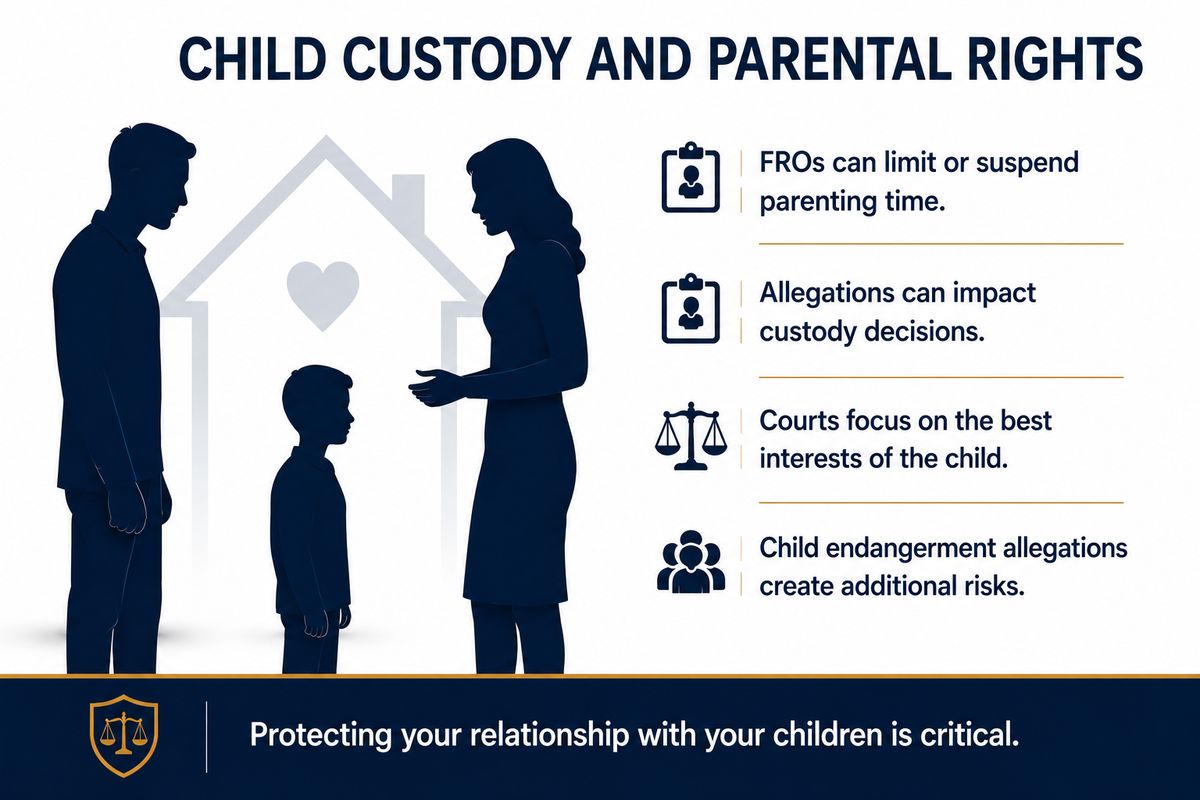
When children are involved, the stakes rise sharply, and a domestic violence finding can reshape a parent’s relationship with their children.
Exposing a child to domestic violence — or engaging in violence in a child’s presence — can give rise to allegations under New Jersey’s endangering the welfare of a child statute (N.J.S.A. 2C:24-4), and can prompt an investigation by the state’s child-protection agency. A parent facing child endangerment charges alongside a domestic violence matter confronts both criminal exposure and powerful consequences for custody.
Custody and parenting time are decided under the best-interests-of-the-child standard, which expressly considers any history of domestic violence. A finding can lead to reduced custody, structured or supervised parenting time, or limits on decision-making authority. Because a restraining order can set temporary custody terms almost immediately — and those early arrangements often influence later decisions — the custody stakes are present from the first day.
A critical caution: where an order restricts contact with a child, a parent must honor it absolutely and restore contact only through the court, never around it. And a parent must never question, pressure, or coach a child about the case — courts and agencies watch for this closely, and it can be devastating.
Immigration Consequences
For non-citizens — including lawful permanent residents — a domestic violence case can be catastrophic in ways unrelated to jail time. Federal immigration law treats domestic violence offenses, stalking, child abuse, and the violation of a protective order as grounds that can render a non-citizen removable (deportable). A crime involving moral turpitude can also affect admissibility, green-card renewal, and naturalization.
Critically, immigration consequences can attach even where the criminal exposure seems minor, and even to a quick plea a defendant might otherwise accept to “make it go away.” Any non-citizen facing a domestic violence allegation should ensure their defense accounts for immigration consequences before any resolution is entered — because a fast, uninformed decision here can be irreversible.
Professional Licensing and Employment
The collateral consequences of a domestic violence case reach deep into a person’s livelihood.
- Employment. A conviction can surface on background checks and disqualify a person from jobs involving security clearances, firearms, finance, healthcare, education, or work with children and vulnerable adults. Even where not disqualifying, disclosure can cost an offer.
- Professional licensing. Licensed professionals — nurses, teachers, healthcare workers, financial advisors, attorneys, and others — may face review by their licensing boards, which can mean investigation, discipline, suspension, or revocation, independent of any criminal penalty.
- Housing. Beyond removal from a shared residence, a domestic violence record can complicate rental applications and affect eligibility for certain public housing.
A striking feature of these consequences is that they can flow from a Final Restraining Order alone — a civil order — even without any criminal conviction.
Expungement and the Central Registry
Many people assume time heals a domestic violence record. The reality is more nuanced, and the divide between the criminal and civil sides is sharp.
| Record | Relief Available |
|---|---|
| Criminal conviction (some DV offenses) | Possible expungement after waiting periods, with exclusions |
| Final Restraining Order | No expungement — only court-ordered dissolution |
| Central Registry entry | Tied to the underlying order’s status |
| Federal firearms prohibition (qualifying conviction) | Can be permanent |
Definition — Domestic Violence Central Registry: A statewide database, accessible to courts and law enforcement, that records domestic violence restraining orders. Because a Final Restraining Order is not a criminal record, it cannot be expunged; the only route out is a court application to dissolve the order.
The practical takeaway is that the best time to limit these consequences is at the outset of the case, when the most options remain — not years later, when relief may be narrow or unavailable.
Rights of the Accused and the Alleged Victim
Rights of the Accused
- The right to remain silent. Statements to police, made under stress and without counsel, frequently become the strongest evidence against a person.
- The right to counsel on the criminal side, including a public defender for those who qualify and face possible incarceration. (Note: there is no court-appointed attorney for the civil restraining order hearing.)
- The presumption of innocence on the criminal charge, which the State must overcome beyond a reasonable doubt.
- The right to be heard at the restraining order hearing — to testify, present evidence, call witnesses, and cross-examine.
- The right to request a reasonable adjournment to retain counsel and prepare.
- Protection against unlawful searches, with the ability to challenge improperly obtained evidence.
Rights of the Alleged Victim
- The right to seek a restraining order and emergency relief, including removal of the accused from a shared home.
- The right to be present at the hearing, to testify, and to present evidence.
- The right to request accommodations and, in appropriate cases, victim services and support.
- The right to have the criminal charge pursued by the State, which controls whether it proceeds.
Understanding both sets of rights is important, because a domestic violence case is an adversarial proceeding in which each side has a genuine role.
Appeals
Both tracks of a domestic violence case can, in appropriate circumstances, be appealed. A Final Restraining Order entered in the Family Part may be challenged on appeal to the Appellate Division of the Superior Court, typically on grounds such as insufficient evidence to satisfy the two-prong test or legal error at the hearing. A criminal conviction may likewise be appealed on legal and evidentiary grounds.
Appeals are technical, deadline-driven, and built on the record made below — which is one more reason the original hearing must be taken seriously and handled with care from the start. A strong record preserves appellate options; a weak one forecloses them.
Common Mistakes to Avoid
Certain errors appear again and again, and each is avoidable:
- Talking to police without counsel, turning stress into evidence.
- Contacting the other party — directly or through third parties — violating an order and creating new charges.
- Posting about the case on social media.
- Deleting messages or evidence, which looks like guilt and destroys helpful context.
- Treating the restraining order as minor and missing the narrow window to contest it.
- Going to the hearing unprepared, facing the Rules of Evidence alone against a represented plaintiff.
- Accepting a quick resolution without weighing firearms, immigration, licensing, and custody consequences.
- Assuming a dropped restraining order ends the criminal case — the two are independent, and only the State can dismiss the charge.
- Waiting too long to get experienced help, after the most important decisions have already been made.
What to Do After an Arrest: A Checklist
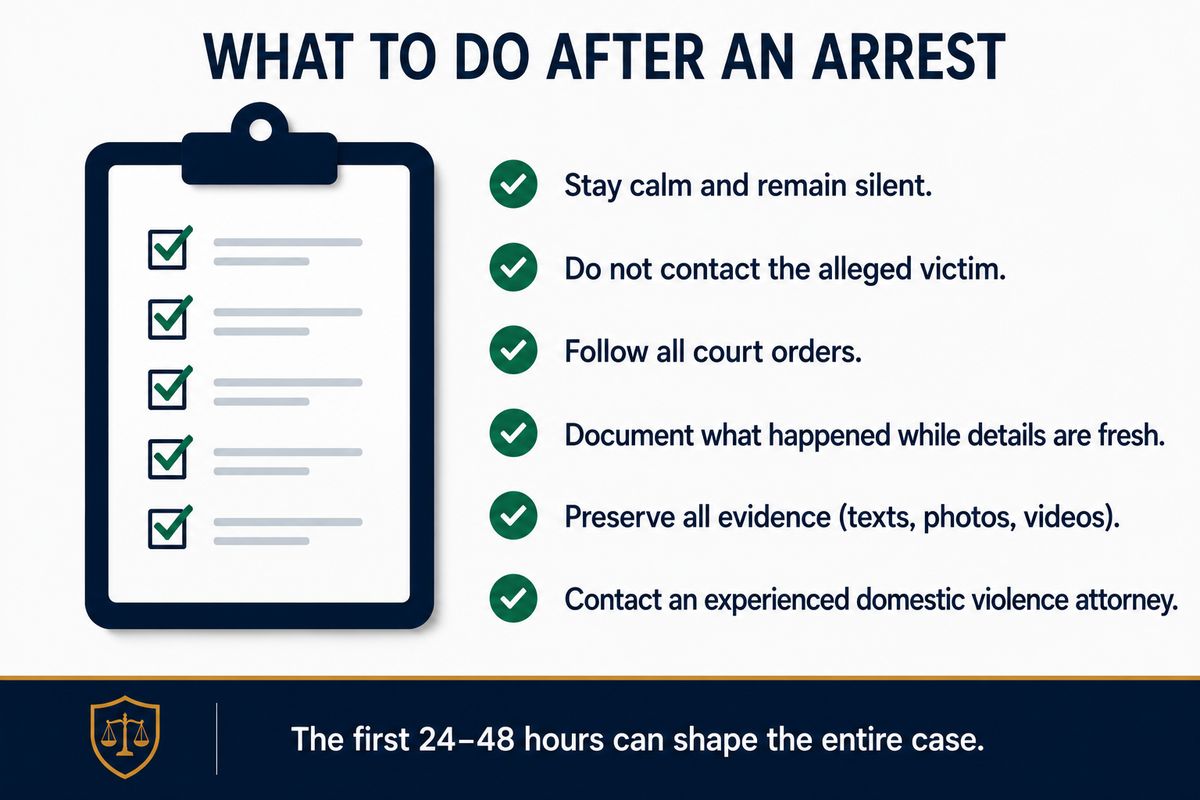
In the first hours and days:
- Stay silent with police beyond providing identifying information; politely decline to give a statement without a lawyer.
- Honor every order — the restraining order and every release condition — without exception.
- Avoid all contact with the alleged victim, through any channel or third party, even if they reach out first.
- Preserve evidence — back up complete text threads, save location records and receipts, secure video, and list witnesses.
- Write a detailed, dated timeline of events while your memory is fresh.
- Do not post about the case on social media.
- Do not delete anything, even harmless messages.
- Contact an experienced domestic violence defense attorney immediately, before the restraining order hearing and before any court date.
When You Need an Attorney: In every domestic violence matter, and as early as possible. The compressed ten-day restraining order timeline and the weight of the earliest decisions make prompt, experienced representation the single most protective step you can take.
Why an Experienced Attorney Matters
The choice of counsel is the most consequential decision a person makes in a domestic violence case, and not every attorney approaches these matters the same way. Domestic violence cases uniquely span both civil and criminal law, unfold on multiple parallel tracks, and carry collateral consequences — firearms, immigration, licensing, custody — that must be anticipated from the start.
The right representation brings:
| Quality | Why It Matters |
|---|---|
| Domestic violence experience | These cases have unique rules across civil and criminal law |
| Command of both tracks | The restraining order and criminal case must be handled together |
| Awareness of collateral consequences | Firearms, immigration, licensing, and custody effects must be anticipated |
| Local familiarity | Knowledge of Bergen County courts and Hackensack practice is a real advantage |
| Clear, honest communication | You need realistic guidance, not false reassurance |
Reviewing an attorney’s background and experience before committing helps ensure the fit is right. Be wary of anyone who guarantees a specific outcome — no honest lawyer can promise results — or who pressures a decision before understanding your case.
Myth vs. Fact
| Myth | Fact |
|---|---|
| “If the accuser drops the charges, everything goes away.” | The State controls the criminal charge, and a judge reviews any request to dismiss a restraining order. |
| “It was just an argument, so it can’t be domestic violence.” | Threats, alarming messages, property damage, and confinement can qualify without any physical contact. |
| “A restraining order is temporary and expires.” | A Final Restraining Order in New Jersey is permanent unless a court dissolves it, and it cannot be expunged. |
| “I own the house, so they can’t make me leave.” | A restraining order can remove even the owner or leaseholder from a shared residence. |
| “The victim can tell police not to arrest me.” | When triggers like signs of injury are present, arrest is mandatory regardless of the victim’s wishes. |
| “I’ll pay bail and go home.” | New Jersey largely eliminated cash bail; release depends on a risk assessment and a judge’s decision. |
| “If I win in state court, I can have my guns back.” | A separate federal prohibition can bar possession regardless of the state outcome. |
| “A quick plea is the fastest way to move on.” | For non-citizens especially, a quick plea can trigger removal; every resolution must be weighed for consequences. |
| “Deleting our old texts will help me.” | Destroying evidence is obstruction and can look like guilt; complete threads often help the defense. |
| “Any criminal lawyer handles these the same way.” | Domestic violence cases span civil and criminal law and reward specific experience. |
Frequently Asked Questions
1. Is domestic violence a crime in New Jersey?
Domestic violence is a legal category, not a single crime. The actual charge is the underlying offense — such as assault, harassment, or terroristic threats — committed within a protected relationship, which triggers both a criminal case and a civil restraining order process.
2. What is the difference between a TRO and an FRO?
A Temporary Restraining Order is granted quickly, often without the accused present, for immediate protection. A Final Restraining Order is entered only after a full hearing where both sides present evidence, and in New Jersey it does not expire.
3. How long after a TRO is the final hearing?
Generally about ten days. That short window is the time to gather evidence, locate witnesses, and secure representation before a hearing that can produce a permanent order.
4. What must be proven to get a Final Restraining Order?
By a preponderance of the evidence, that the defendant committed a predicate act of domestic violence and that a restraining order is necessary to protect the plaintiff from further abuse. Both parts must be met.
5. Can I be arrested even if my partner doesn’t want to press charges?
Yes. When triggers like signs of injury or a weapon are present, arrest is mandatory regardless of the alleged victim’s wishes.
6. Will I have to pay cash bail?
Generally no. New Jersey largely replaced cash bail in 2017 with a risk-based system; a judge decides release conditions, or the prosecutor may seek pretrial detention.
7. Does domestic violence require physical contact?
No. Harassment, cyber-harassment, stalking, and terroristic threats can all support a case without any physical contact.
8. Can texts or social media posts lead to charges?
Yes. Repeated or threatening electronic communications can support harassment, cyber-harassment, stalking, or terroristic threats.
9. What happens if I contact the protected person by accident?
Any contact can be charged as criminal contempt, even if the other person initiated it. A second violation carries a mandatory jail term. Do not respond to any message.
10. Can a restraining order affect my gun rights?
Yes. A restraining order requires surrender of all firearms, revocation of the Firearms Purchaser Identification card, and a prohibition on possession while the order stands.
11. Can I lose my firearms without a conviction?
Yes. A Final Restraining Order alone can result in loss of firearms and a prohibition on possession, entirely apart from any criminal conviction.
12. Will a domestic violence case affect my immigration status?
It can. Federal law treats domestic violence offenses, stalking, child abuse, and violating a protective order as grounds that may make a non-citizen removable. Any resolution should be evaluated for immigration effects first.
13. Can I lose my professional license?
Possibly. Licensing boards in fields like healthcare, education, and finance may investigate and discipline members based on a domestic violence conviction, and sometimes an order, independent of any criminal penalty.
14. Will a domestic violence case affect my custody?
It can. Custody and parenting time are decided under the best-interests-of-the-child standard, which expressly considers any history of domestic violence, and a finding can lead to reduced or supervised parenting time.
15. Can I be charged with child endangerment if my child witnessed an incident?
Possibly. New Jersey’s endangerment statute is broad, and exposing a child to domestic violence can give rise to allegations even without direct harm to the child.
16. How much jail time can a domestic violence charge carry?
It depends on the offense grade — from up to 30 days for harassment to 5–10 years or more for a second-degree aggravated assault, with certain violent crimes requiring roughly 85% of the sentence before parole eligibility.
17. Does a Final Restraining Order go on my criminal record?
No. It is a civil order and does not create a criminal record, but it is entered in the Domestic Violence Central Registry, never expires on its own, and triggers firearms and other consequences.
18. Can a domestic violence conviction be expunged?
Some domestic violence-related convictions may be expungeable after waiting periods, subject to exclusions. A Final Restraining Order cannot be expunged and can only be ended through court-ordered dissolution.
19. What should I do first if I’m falsely accused?
Preserve all evidence, avoid any contact with the accuser, do not speak to police without counsel, and consult a defense attorney immediately. Never pressure anyone to recant — that is a separate crime.
20. Where are Bergen County domestic violence cases heard?
Restraining order matters are handled by the Family Part at the Bergen County Justice Center in Hackensack; indictable criminal charges go to the Criminal Division there, while lesser offenses may be heard in municipal court.
21. Do I need a lawyer for the restraining order hearing if I already have one for the criminal case?
Yes — they are the same case in practice and should be handled together. The restraining order hearing has no court-appointed counsel, and its outcome affects firearms, custody, and the criminal matter.
22. Can a Final Restraining Order ever be removed?
Yes, but only by court order and only on a showing of substantially changed circumstances, evaluated under a demanding multi-factor test. It is difficult, which is why contesting the original hearing matters so much.
Glossary of Legal Terms
- Prevention of Domestic Violence Act (PDVA): New Jersey’s governing domestic violence statute, N.J.S.A. 2C:25-17 et seq.
- Predicate act: A specific offense that, in a protected relationship, constitutes domestic violence.
- Protected relationship: A statutory relationship category (spouse, former spouse, household member, child in common, dating relationship) that brings conduct within the Act.
- TRO (Temporary Restraining Order): A short-term emergency protective order, often granted ex parte.
- FRO (Final Restraining Order): A permanent protective order entered after a full hearing.
- Ex parte: A proceeding with only one party present.
- Preponderance of the evidence: The civil standard — more likely than not.
- Beyond a reasonable doubt: The higher criminal standard of proof.
- Two-prong test: The requirement that a final restraining order rest on both a predicate act and a genuine need for protection.
- Family Part: The division of the Superior Court that handles restraining order and custody matters.
- Complaint-warrant / complaint-summons: Charging documents that determine whether the accused is held in custody or released.
- Pretrial detention: Holding a defendant in custody until the case concludes, on the State’s motion.
- Contempt: The crime of violating a court order, including a restraining order.
- Forfeiture: A proceeding by which the State seeks to keep seized weapons permanently.
- Domestic Violence Central Registry: New Jersey’s statewide database of domestic violence orders.
- Expungement: The legal clearing of certain criminal records.
- Dissolution: A court’s cancellation of a Final Restraining Order.
- Removability: A non-citizen’s exposure to deportation based on certain offenses.
- No Early Release Act: A law requiring roughly 85% of a sentence to be served before parole for certain violent crimes.
Conclusion
A domestic violence accusation in New Jersey can upend a life in a single day — the home, the children, the firearms, the reputation, and the freedom all placed at risk before the facts are ever tested. What makes these cases survivable is understanding that they are not a single, unstoppable event but a structured process with real rules, real burdens of proof, and real defenses. The two tracks can be fought. The two-prong test can be contested. False or exaggerated claims can be exposed. Firearms, custody, immigration, and licensing consequences can be anticipated and managed. But the window is narrow, and it opens the moment the papers are served.
If you are facing a restraining order or a domestic violence charge in Hackensack or anywhere in Bergen County, the most important step you can take is to get clear, experienced guidance before the ten-day clock runs out and before the earliest decisions are made without you. A coordinated defense — one that handles the restraining order and the criminal charge together, protects your rights at every stage, and weighs every consequence — is what stands between an allegation and a permanent mark on your life.

Speak With a Bergen County Domestic Violence Attorney Today. Our firm defends people facing restraining orders and domestic violence charges throughout Hackensack and Bergen County. Contact us for a confidential consultation to understand your rights and start building your defense while every option is still open — reach out to our team today.
This page is provided for general informational purposes and does not constitute legal advice. Laws and procedures change, and every case is different. For advice about your specific situation, consult a licensed New Jersey attorney.